Why Timber Retaining Walls Fail & How We Fix Bowing Walls
Timber retaining wall bowing or leaning? We explain why these walls fail, how proper drainage and deadman anchors work, and what it takes to fix a bowing wall.
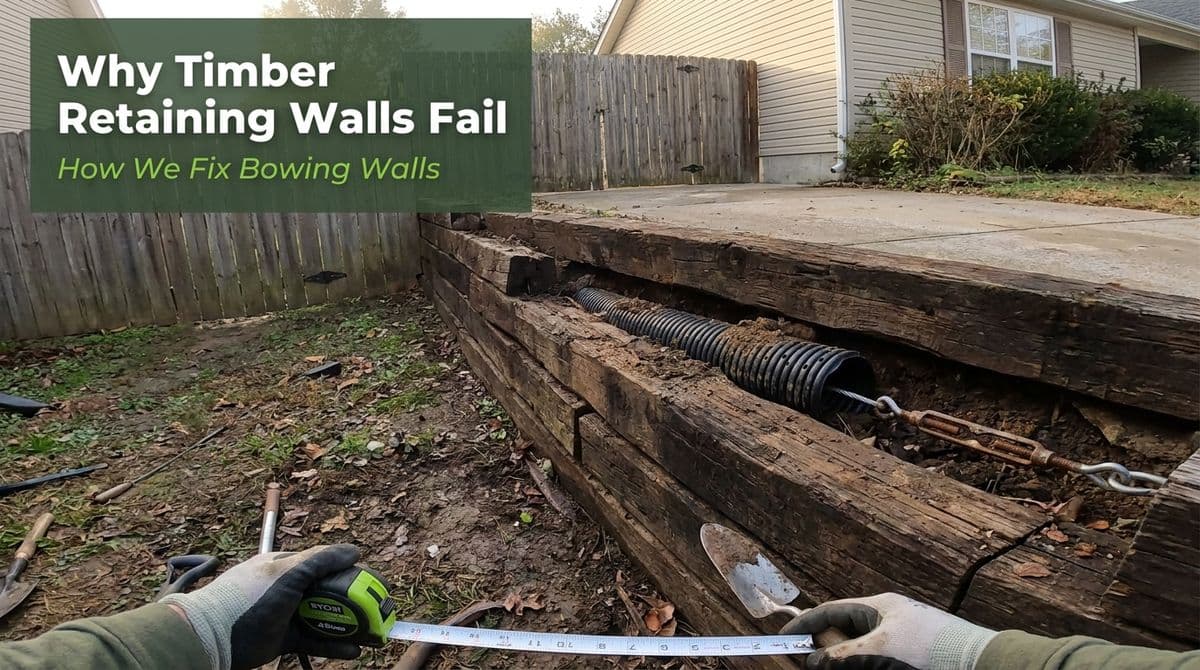
Why Timber Retaining Walls Really Fail
We recently got a call from a homeowner — let’s call her Jenna — who had a timber retaining wall that was bowing out badly. The wall was only about eight years old, built to replace an older wall made of bridge planks and railroad timbers. Structurally, the new timbers were still solid and not rotting, but the wall was clearly leaning and starting to move.
As Jenna described it, she suspected exactly what we often find on these projects: no proper drainage behind the wall, backfill that was mostly soil instead of gravel, and no deadman anchors tying the wall back into the hill. By the time she called us, she knew the wall needed to be excavated, straightened, anchored, and rebuilt the right way.
From our side of the fence, what we heard in that one phone call is a pattern we see over and over with timber walls. Even conscientious builders can miss a few critical details, and eight or ten years later the wall starts to bow, lean, and fail. In Jenna’s case — and in most similar calls we get — the story comes down to the same three issues: drainage, anchoring, and backfill.
The Three Main Reasons Timber Retaining Walls Bow
1. Poor or Missing Drainage
When we inspect a failing timber wall, the first thing we look for is drainage. In Jenna’s situation, she told us there was no drain pipe at the base of the wall — just soil backfilled right against the timbers. That’s a red flag for us.
Here’s what happens without drainage:
- Rain and snowmelt soak into the soil behind the wall.
- Water can’t escape, so the soil becomes saturated and heavy.
- Hydrostatic pressure builds up and pushes on the wall 24/7.
- Over time, the timbers begin to bow and lean outward.
We can usually confirm this on site by looking for damp soils behind the wall, stains or wet spots on the timbers, and sometimes even small sinkholes forming in the yard above.
2. No Deadman Anchors or Tiebacks
The second thing we ask about is how the wall is anchored. During Jenna’s call, she mentioned there were no deadman anchors installed at all. That lined up perfectly with the bowing we were hearing about.
Deadman anchors (also called tiebacks) are timbers or steel rods that run perpendicular to the wall, back into the slope, and are buried in compacted soil or gravel. We rely on them to:
- Tie the front face of the wall into the stable soil behind it.
- Resist the outward force of the soil and water pressure.
- Distribute loads so no single part of the wall takes all the stress.
Without those anchors, a timber wall is basically just a heavy fence trying to hold back a hillside. It might look fine for a few years, but as the pressures increase, the wall starts to creep outward.
3. The Wrong Backfill Material
The last piece of the puzzle is what’s sitting behind the wall. In Jenna’s case, the previous contractor had backfilled with native soil — not gravel — which is something we see a lot when walls are built by someone who hasn’t done many large retaining projects.
Here’s why that matters:
- Soil absorbs and holds water; gravel drains it away.
- Wet soil is much heavier than free-draining gravel.
- Clay or silty soils expand when wet, adding even more pressure.
When we redo walls like this, we almost always find that the “dirt-only” backfill is a big contributor to the bowing and movement.
How We Fix a Bowing Timber Retaining Wall
When we walked through options with Jenna, we outlined the basic process we typically follow on a wall like hers. Every property is a little different, but the steps are usually similar.
Step 1: Careful Excavation and Assessment
Our first move is to relieve the pressure behind the wall. That means excavating the soil away in a controlled way so we don’t cause a sudden collapse. Once the pressure is off, we can:
- Check the timbers for rot, insect damage, or splitting.
- Evaluate how much the wall has shifted and whether any sections need full replacement.
- Confirm footing depth and overall stability at the base.
In many eight- to ten-year-old walls, like Jenna’s, we find the wood itself is still usable; it’s the design and drainage that failed.
Step 2: Installing Proper Drainage
Next, we correct what should have been there from the start:
- Install a perforated drain pipe at the base of the wall on the uphill side.
- Wrap the pipe in fabric (if needed) to keep fines out.
- Backfill around the pipe and up behind the wall with washed drain rock, not soil.
- Provide a safe outlet so the water can daylight or tie into an approved drainage system.
We design that system so water naturally finds the pipe and moves away instead of building up pressure behind the timbers.
Step 3: Adding Deadman Anchors or Tiebacks
Once drainage is handled, we address anchoring. For a timber wall that’s already in place, we typically:
- Install deadman timbers at set intervals (often every 6–8 feet, depending on height and loads).
- Run those timbers back into the hill, perpendicular to the wall.
- Secure them to the face timbers with through-bolts or structural hardware.
- Embed the deadmen in compacted gravel or competent soil so they can “lock in.”
If we’re working with a taller wall or challenging soils, we may recommend engineered helical tiebacks or other specialty anchors and bring in an engineer to size and locate them properly.
Can a Bowing Timber Wall Be Saved?
One of Jenna’s big questions to us was whether she had to completely rebuild the wall, or if we could straighten and reinforce it. That’s the same question we hear on many calls.
Our answer depends on what we find when we open things up, but here are some general guidelines we use on site:
- Timbers are still solid, wall has minor to moderate bowing: We can often straighten sections, add anchors, improve drainage, and keep much of the existing structure.
- Timbers are rotting or severely split: We usually recommend replacing those members or considering a different wall material.
- Wall is very tall or close to a structure: We often involve an engineer and may suggest a more robust system (block, concrete, or engineered timber design).
In Jenna’s case, her instincts were good: excavate, add drainage and gravel, install deadman anchors, and reassemble the wall correctly. Our job is to make sure that plan is executed safely and to modern best practices.
What You Can Look For at Home
If you have a timber retaining wall, you can do a quick visual check before you call us (or another pro):
- Is the wall leaning or bowing outward anywhere?
- Do you see bulges or individual timbers pushed forward?
- Is there a way for water to escape, or does it seem to just sit behind the wall?
- After rain, do you notice standing water above the wall or soggy ground?
- Can you spot any visible deadman timbers running back into the hill?
The more of those warning signs you see, the more important it is to have someone look at it sooner rather than later. Walls rarely fix themselves, and the earlier we step in, the more of your existing structure we can usually save.
If your timber wall is starting to bow like Jenna’s, we’re happy to come out, take a look, and talk through whether repair, reinforcement, or full replacement makes the most sense for your property.